Having enjoyed it as an eight-year-old boy, Alex Wheatle re-reads Robinson Crusoe and reflects on its themes of imperialism and slavery. In this series of Essays, recorded in front of an audience at the 2019 Hay Festival, five writers respond to the themes of Daniel Defoe’s ‘Robinson Crusoe’. Often described as the first novel, it's a story which still resonates, three hundred years after it was written, but also preserves the attitudes of its time. Fiona Stafford, Horatio Clare, Alex Wheatle, Alys Conran and Daniel Hahn reflect on the novel as a tale of exotic adventure, a study of isolation and a fantasy of colonial encounter.
from The Essay https://bbc.in/2JKDH0L
Thursday, 30 May 2019

A Geographic Perspective of Financial Distress
There is a fascinating research piece by the St. Louis Federal Reserve Bank: The Unequal Recovery: Measuring Financial Distress by ZIP Code.” They used a clever data analysis to delve more deeply into household finances by Zip Code across different time periods, most notably since the Fed begin its current tightening cycle in 2015 –…
The post A Geographic Perspective of Financial Distress appeared first on The Big Picture.


from The Big Picture http://bit.ly/2JNUKyS
via IFTTT
10 Wednesday AM Reads
My mid-week morning train reads: • Crowds: What Mount Everest Teaches Us About Alpha (Reformed Broker) • It’s the middle of the night. Do you know who your iPhone is talking to? (Washington Post) • Bartlett: Modern Monetary Theory: is warmed over Laffer curve (Milken Institute Review) • Investing in the Podcast Ecosystem in 2019…
The post 10 Wednesday AM Reads appeared first on The Big Picture.


from The Big Picture http://bit.ly/2MbTGXw
via IFTTT
Visualizing How Signals Travel In A PCB
If you play with high speed design for long enough, eventually you’re going to run into clock skew and other weird effects. [Robert Feranec] recently ran into this problem and found an interesting solution to visualizing electric fields in a PCB.
A word of warning before we dig into this, for most of the projects we see on Hackaday something like this is completely superfluous. There aren’t many people dealing with high speed interfaces here, and there aren’t many people dealing with 100 Gigabit per second data links, period. That said, it’s not unheard of, and at the very least it’s interesting to look at.
The basics of this video is simulating the signals visually in a differential pair on a (virtual) printed circuit board. The software for this is Simbeor, and [Robert] talked to the founder of the company behind this software after watching a video on simulating electric fields in differential traces. This software does what it says, and is a great illustration of why differential pairs must have the same length.
While this might not be for everyone, it is a fantastic visualization of signals in high-speed design that goes above and beyond what you would expect from a Spice simulation. Even if you’re not doing high-speed design, you may someday and it’s never too soon to get an intuitive understanding of how electrons work.
from Hackaday http://bit.ly/2QGuQOl
Drag And Drop Files On Select Arduino Boards
Historically, getting files on to a microcontroller device was a fraught process. You might have found yourself placing image data manually into arrays in code, or perhaps repeatedly swapping SD cards in and out. For select Arduino boards, that’s no longer a problem – thanks to the new TinyUSB library from Adafruit (Youtube link, embedded below).
The library is available on Github, and is compatible with SAMD21 and SAMD51 boards, as well as Nordic’s NRF52840. It allows the Arduino board to appear as a USB drive, and files can simply be dragged and dropped into place. The library can set up to use SPI flash, SD cards, or even internal chip memory as the storage medium.
Potential applications include images, audio files, fonts, or even configuration files. Future plans include porting the TinyUSB library to the ESP32-S2 as well. Being able to drag a settings file straight on to a board could make getting WiFi boards online much less of a hassle.
We’ve seen other nifty USB libraries before, VUSB is a great option if you need USB on your AVR microcontroller. Video after the break.
from Hackaday http://bit.ly/2wtDlCO
Tiny Two-Digit Thermometer Has Long Battery Life
Like most of his work, this tiny two-digit thermometer shows that [David Johnson-Davies] has a knack for projects that make efficient use of hardware. No pin is left unused between the DS18B20 temperature sensor, the surface mount seven-segment LED displays, and the ATtiny84 driving it all. With the temperature flashing every 24 seconds and the unit spending the rest of the time in a deep sleep, a good CR2032 coin cell should power the device for nearly a year. The board itself measures only about an inch square.
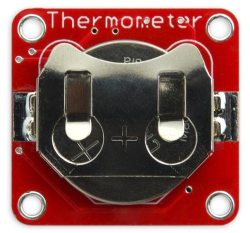 You may think that a display that flashes only once every 24 seconds might be difficult to actually read in practice, and you’d be right. [David] found that it was indeed impractical to watch the display, waiting an unknown amount of time to read some briefly-flashed surprise numbers. To solve this problem, the decimal points flash shortly before the temperature appears. This countdown alerts the viewer to an incoming display, at the cost of a virtually negligible increase to the current consumption.
[David]’s project write-up explains how everything functions. He also steps through the different parts of the source code to explain how everything works, including the low power mode. The GitHub repository holds all the source files, and the board can also be ordered direct from OSH Park via their handy shared projects feature.
Low power consumption adds complexity to projects, but the payoffs can easily be worth the time spent implementing them. We covered a detailed look into low power WiFi microcontrollers that is still relevant, and projects like this weather station demonstrate practical low power design work.
from Hackaday http://bit.ly/2XdvmWo
Turbo Subaru Gets DIY Gauges
For the average motorist, the speedometer and the fuel indicator are the primary gauges of interest. Owners of performance or modified cars tend to like having more information on the way the car is running. [JustinN1] is firmly in that camp, and built some WiFi-enabled gauges for his Subaru WRX STi.
The gauges run on the ESP32 platform, chosen for its WiFi hardware and its ease of use with the Arduino platform. This makes programming a snap, and interfacing to a smartphone easy. OLED displays were chosen for their good visibility in both day and night conditions, which is important for automotive applications.
[JustinN1] developed both a boost/vacuum gauge and an oil pressure gauge, both useful for keeping an eye on what the engine is doing. Measuring boost is as simple as using an off-the-shelf analog air pressure sensor. The oil pressure sensor is a resistive part, and must is hooked up through a resistor divider to create an analog voltage for the ESP32 to read.
Code is on Github, and there’s even a version that displays a grinning face when you get into higher boost levels. There are also a series of housings to suit various mounting choices, to help give the gauges a more finished look. We’ve seen other gauge builds too, like this gear indicator for a Suzuki motorcycle. Video after the break.
from Hackaday http://bit.ly/2XhLZQI
Subscribe to:
Posts (Atom)